David Lynch Was Not an Ironist
Twin Peaks, Dostoevsky, and the embarrassment of goodness
David Lynch is often called postmodern, and the description makes sense at the level of form. Twin Peaks is built from television ruins: soap opera, police procedural, small-town melodrama, noir, horror, sitcom, occult mythology, dream sequence, commercial break. Its surfaces are artificial. Its dialogue can sound as if American life had been reconstructed from diner menus, perfume ads, police files, family secrets, and radio static. Characters double. Time slips. Clues refuse ordinary resolution. Symbols arrive with the force of revelation and then refuse paraphrase.
But Lynch was not an ironist.
He used the materials of postmodern culture without accepting the protective posture that often travels with them. He did not place sincerity in quotation marks. He did not expose goodness in order to humiliate it. He did not treat evil as a childish category to be dissolved into discourse, pathology, trauma, or institutional failure. His work is formally unstable, but morally exposed. It is filled with masks, doubles, performances, codes, artificial rooms, theatrical gestures, and corrupted surfaces, yet it never concludes that everything is only performance. It asks what happens when performance conceals something real.
The doubling is crucial. Lynch’s doubles are not playful signs that identity is fluid or that the self is merely constructed. They are wounds in the order of personhood: bodies without the same soul, faces detached from the life they once carried, images of the self copied, manufactured, or occupied. The double does not free the self into plurality. It asks what remains when a person’s form survives after the person has been violated, replaced, or hollowed out.
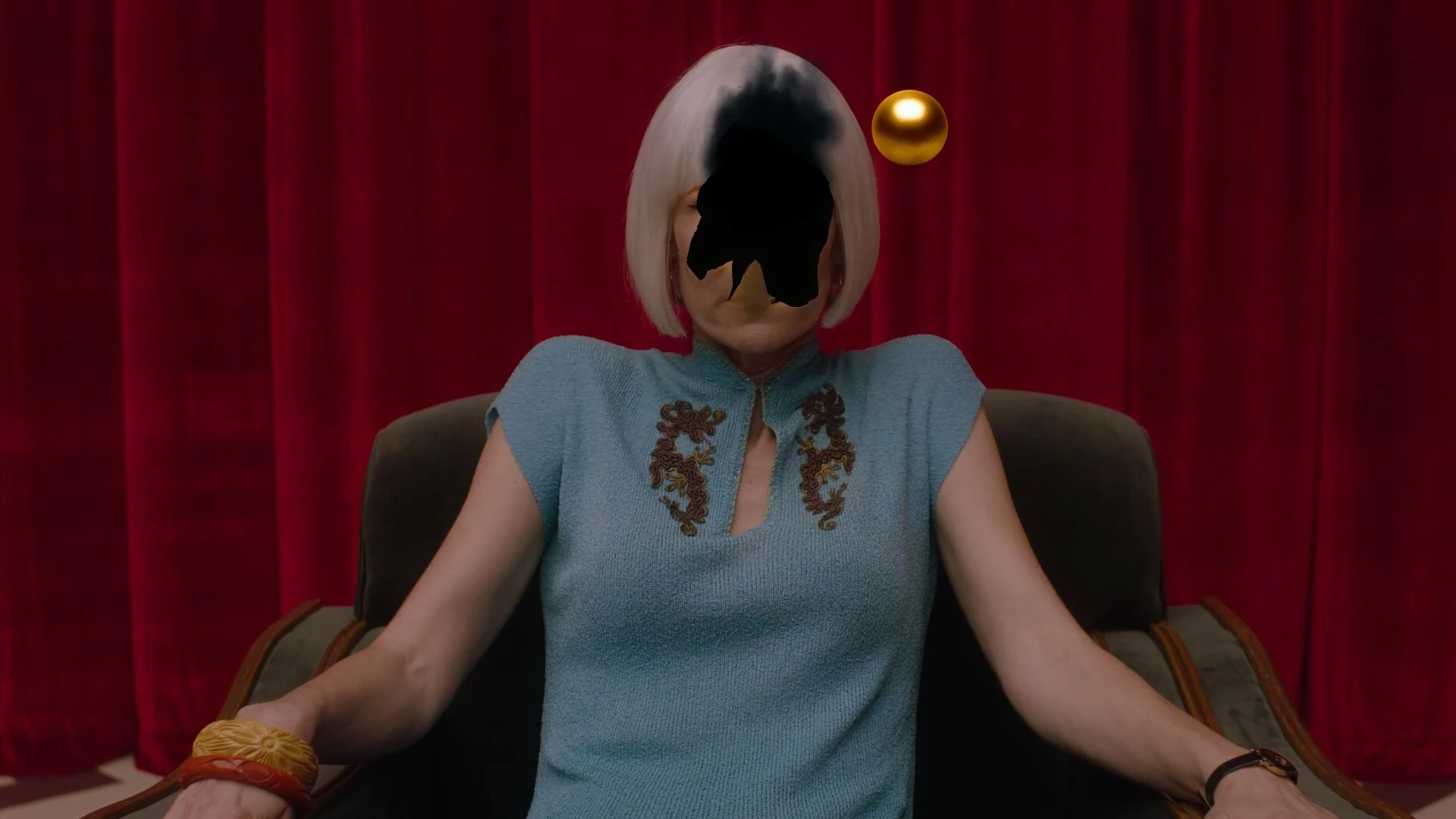
Lynch is sometimes mistaken for a conservative artist because he permits goodness and evil to appear without apology. Twin Peaks has a White Lodge and a Black Lodge. It has characters who are almost embarrassingly decent, and others whose charm bends around concealed appetite. It gives innocence metaphysical weight. It gives corruption a smell, a sound, a room, a voice. To a critical culture trained to treat moral polarity as simplification, this can look reactionary.
The charge fails because Lynch’s world offers no restoration fantasy. The family is not safe. The small town is not innocent. Respectability conceals predation. Institutions lie. Technology conducts forces no one governs. The living room can become a crime scene, the diner a stage, the woods a threshold, the home the place where the worst thing in the world happens. Lynch does not defend order against corruption. He shows order already saturated by corruption.
Irony protects the viewer from contact. It offers distance, superiority, a way to recognize the cliché without being wounded by it. Lynch removes that protection. The soap-opera excess is funny until it is not. The simple line sounds absurd until it cuts. The red curtain is theatrical until it becomes a metaphysical surface. Lynch does not rescue sincerity by making it tasteful. He leaves it exposed.
Dostoevsky belongs near him. Prince Myshkin in The Idiot appears foolish because he lacks the defensive grammar of a corrupt world. He does not know how to convert intelligence into concealment. He does not protect himself through irony, calculation, or controlled ambiguity. His directness embarrasses everyone around him because it reveals how much social intelligence depends on evasion. The world calls him an idiot not because he has no depth, but because his form of depth has no armor.
Lynch’s good characters carry that Dostoevskian burden in different registers. Agent Cooper, Sheriff Truman, Andy, Lucy, Major Briggs, the Log Lady, even Albert Rosenfield after his defensive surface cracks: none of them is reducible to simple-minded decency. They are figures of attention, ritual, discipline, attunement, or moral refusal. Their seriousness survives absurdity.
Major Garland Briggs is the cleanest example. He is a military man who speaks in solemn, almost liturgical phrases. He belongs to the state’s secret apparatus, yet he carries himself less like a bureaucrat of violence than a custodian of mysteries. His speech has no fashionable texture. He is paternal, formal, patient, and metaphysical. In the wrong show, he would be a joke about square authority. In Lynch’s world, he becomes one of the few characters capable of moral gravity without theatrical corruption.
The scene with Bobby is almost impossible by contemporary standards. A father tells his rebellious son that he dreamed of him standing before him in harmony and joy. The speech is not cool. It is not defended by a comic cutaway or by some signal that the viewer should not take it seriously. Bobby’s tears are not used to degrade him. The scene risks embarrassment because embarrassment is the price of unprotected feeling.
The later interrogation by Windom Earle gives Briggs’s sincerity its severity. Asked what he fears most, Briggs answers that he fears the possibility that love is not enough. The line rejects two easier positions at once: the cynic’s belief that love is decorative, and the sentimentalist’s belief that love automatically saves. Briggs can speak vulnerably without converting vulnerability into performance.
Albert Rosenfield complicates the pattern. He enters the show as abrasive intelligence: forensic, impatient, contemptuous of local sentiment, armed with expertise and sarcasm. He seems to belong to the world of ironic superiority. The town grieves and blunders; Albert cuts, diagnoses, insults, and refuses ceremony. At first he appears to confirm the hierarchy between the knowing outsider and the provincial scene.
Lynch does not leave him there. Albert’s sarcasm is not nihilism. It is armor. Beneath the performance is a severe ethical commitment. His speech on nonviolence and love is startling because it comes from the character most equipped to mock such a speech. The turn does not convert Albert from intelligence into innocence. It shows intelligence released from cruelty.
Andy and Lucy are comic, but their comedy is not contempt. A purely ironic show would use them as provincial stupidity, background innocence for the knowing viewer to mock. Lynch lets them be ridiculous without reducing them to ridicule. Their innocence is not wisdom in disguise, but it is also not nothing.
The wine-tasting scene gives them their sharpest comic form. Dick Tremayne turns refinement into performance: taste as status, sophistication as condescension, culture as a small theater of superiority. Andy tries to participate with literal seriousness, while Lucy watches the whole thing curdle into insult. Dick’s polish is the more absurd thing. Andy and Lucy are funny because they do not command the codes of cultivated performance; Dick is funny because he does, and the codes reveal almost nothing except vanity.
The Log Lady belongs at the center of this argument because she makes Lynch’s sincerity impossible to confuse with sweetness. She is strange, severe, wounded, and often opaque. She carries a log. She speaks as if the ordinary world is full of messages almost nobody has learned to receive. A purely ironic show would turn her into a joke about rural weirdness. Lynch allows the joke to exist, but he refuses to let it exhaust her.
In the “Sadness” introduction, the Log Lady says there is sadness in the world because “we are ignorant of many beautiful things,” including “the truth.” Then she turns to tears: ducts, moisture, the physical passage of sorrow through the body. The speech refuses the division between knowledge and grief, body and spirit, truth and feeling. Sorrow is not treated as mood or private weakness. It is a sign of estrangement from reality, and also something that passes through flesh.
Her ridiculousness becomes a test. Can the viewer hear a strange person speak strangely about sorrow without retreating into superiority? Can truth arrive through damaged, eccentric, socially embarrassing forms? Lynch does not ask us to admire the Log Lady because she is normal beneath the weirdness. He asks whether normality may be the wrong standard.
The evil characters speak differently. They hide, flatter, seduce, threaten, mimic, and perform. Their language bends around appetite. They do not merely lie; they create atmospheres in which direct speech becomes difficult. Evil in Lynch is theatrical, but not harmless. It knows how to use surfaces. The businessman, the seducer, the double, the respectable citizen, the charming stranger: these are masks through which appetite enters the social world.
The atomic sequence in The Return gives the postmodern surface a darker history. Human beings build the bomb; something inhuman appears in its wake. The sequence does not deny history by turning evil into myth. It mythologizes history because the event exceeds ordinary historical containment. The bomb is technical, institutional, military, bureaucratic, and material. It is also apocalyptic.
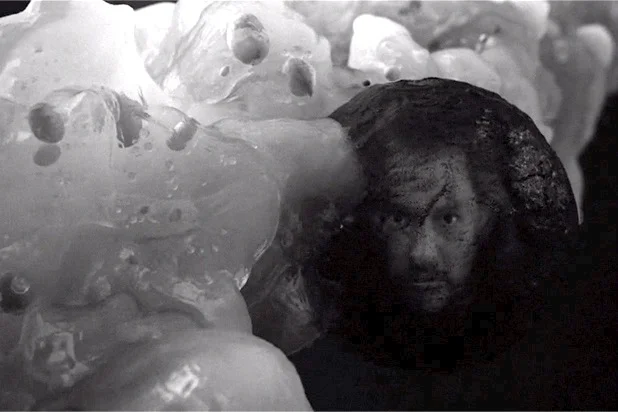
Evil may be the work that men do, but the evil that men do does not necessarily stay human-sized. It accumulates. It enters rooms, habits, families, institutions, images, technologies, and atmospheres. It becomes something later people encounter as if it had always been there. Human actions produce forces that come back as places, images, voices, and compulsions.
Fire Walk with Me deepens the moral exposure by returning Laura Palmer to the center. In the original series, she is the dead girl around whom the town organizes grief, denial, desire, and investigation. In the film, she becomes unbearably present. We see the daily structure of her terror: addiction, sexual exploitation, tenderness, contempt, performance, knowledge, and dread. She knows more than the town can bear knowing. Her pain is not an aesthetic device. It is the wound from which the mythology emerges.
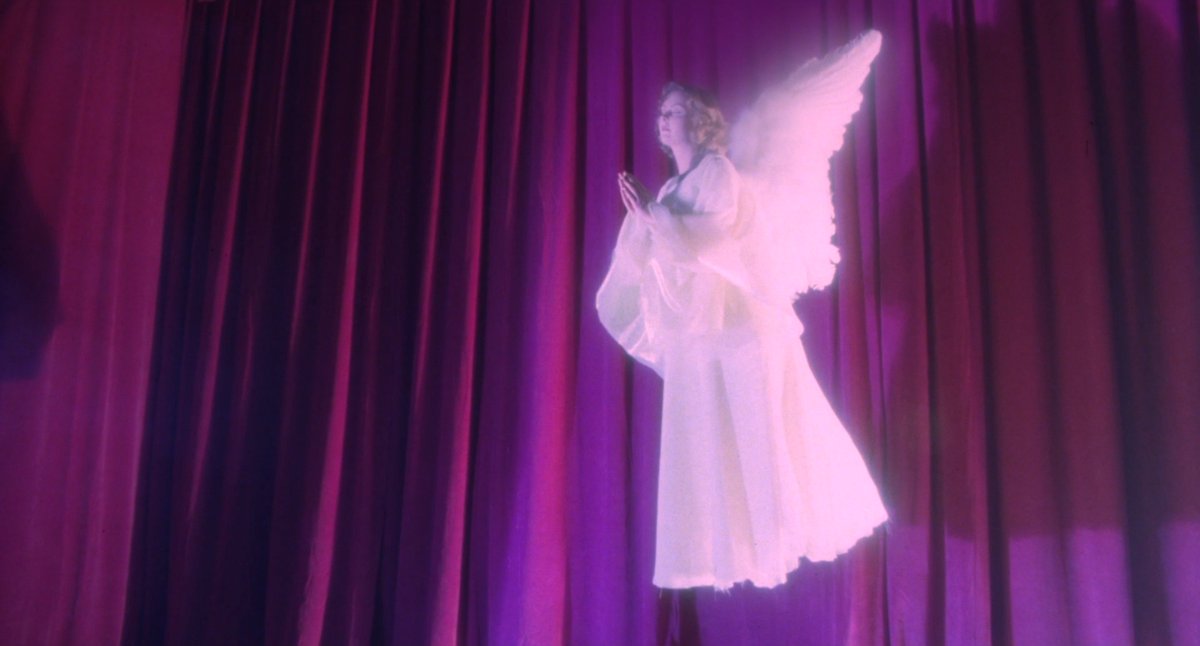
The angel at the end of Fire Walk with Me should not work. It is too direct, too religious, too vulnerable to embarrassment. But after everything Laura has endured, irony would be the true obscenity. The angel does not explain the suffering or cancel it. It refuses to let suffering have the last symbolic word. Lynch risks sentiment because the alternative would be a colder falseness: the refusal to let grace appear unless it has first been protected by distance.
To call Lynch conservative because he believes in evil and innocence is to miss the greater provocation. The scandal is non-ironic moral seriousness after irony has become a default sign of intelligence. Lynch’s work suggests that a person can know the world is theatrical without treating everything as theater, know that symbols are unstable without denying that some symbols wound and others redeem, know that innocence can be ridiculous without assuming ridicule is the highest form of knowledge.