The Backrooms After the Zone
Stalker, trauma, simulation, and the horror of liquid modernity
Kane Parsons’s Backrooms and Andrei Tarkovsky’s Stalker are organized around the same spatial fantasy: a passage into a world where the ordinary coordinates of reality no longer hold. In each film, someone enters a forbidden or hidden space in which familiar institutions lose their authority, perception becomes unreliable, and the environment appears to obey rules that cannot be mastered. The resemblance is real, but the historical difference is more revealing. Stalker was made from within the memory of solid institutional forms. Backrooms is made from inside their liquefied aftermath.
Zygmunt Bauman’s Liquid Modernity gives one language for this shift. Bauman argued that the solid structures of modern life, including stable institutions, durable identities, collective projects, and long-term obligations, had given way to a more fluid world of mobility, uncertainty, privatization, and individualized responsibility. My dissertation, Post-Bureaucratic Organizations, approached a related problem through organizational sociology. I studied what happens when organizations reject formal hierarchy but still need coordination, discipline, and order. The argument was not that authority disappears after bureaucracy. It migrates. In some organizations, authority moves into norms, culture, identity, and informal status. In others, it moves into technical systems, metrics, platforms, and opaque rules. Post-bureaucracy is not the end of control. It is control after the old institutional forms have partially dissolved.
This is why Stalker and Backrooms belong in the same conversation. Both are spatial myths of institutional liquefaction. They imagine worlds in which ordinary pathways cannot be trusted, where rules remain active but unintelligible, and where meaning survives only as rumor, ritual, danger, or obsession. Stalker, however, still remembers the solidity whose breakdown it contemplates. It carries the residues of science, art, state power, religion, literature, bureaucracy, industry, and collective historical failure. Backrooms comes later. It does not depict a world in which solid institutions are melting around us. It depicts a world in which the melt has already become the atmosphere.
The Zone in Stalker is frightening because it is neither fully natural nor fully institutional. It is forbidden territory, guarded and rumored about, crossed through ritual, and littered with remnants of industry, military secrecy, scientific ambition, and spiritual dread. The three central figures are not individualized in the contemporary therapeutic sense. They are social and metaphysical types: the Stalker, the Writer, and the Professor. The Zone forces them to confront the failure of their roles, but those roles still have density. The Writer carries the exhaustion of art and language. The Professor carries the authority and impotence of science. The Stalker carries vocation, humiliation, faith, and dependence on a sacred space that no longer belongs to any stable church or public order.
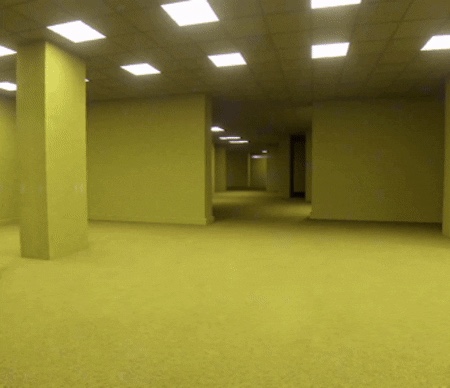
Backrooms is different because its labyrinth is not the forbidden outside of a still-recognizable society. It is the inside of a world whose outside has become difficult to imagine. The horror does not come from entering a mysterious territory beyond the social order. It comes from falling through the floor of reality into a bad infinity of generic interiors: office corridors, waiting rooms, institutional carpets, fluorescent grids, blank walls, storage areas, school-like passages, and spaces that seem copied rather than built. The Backrooms are corporate architecture without corporation, bureaucracy without bureaucrats, a work environment after work has vanished, and an institutional interior without an institution that can be addressed, petitioned, blamed, or overthrown.
The Backrooms feel less like a supernatural place than a diagnosis of contemporary experience because they are not alien enough. They are made from the residual spaces of late capitalist life: office parks, dead malls, hotel corridors, suburban basements, conference centers, medical facilities, call centers, school hallways, and the bland passageways through which people move without ever feeling at home. They do not show institutional collapse by presenting us with ruins. They show us something stranger: institutional form after it has become pure environment. There are walls, lights, corridors, thresholds, systems, and dangers, but no stable account of what they are for.
Stalker’s Zone is a place of danger because it may still contain truth. The Room is said to grant one’s innermost desire, and the dread of the film comes from the possibility that people do not know what they want, that desire may be truer and more terrible than intention. Faith may be necessary but humiliating. Science may be powerful but spiritually barren. Art may be exhausted and vain, yet still unable to stop speaking. The Zone is philosophical because it stages the breakdown of meaning against a world in which meaning remains a collective problem. The question is not simply what happened to a wounded individual, but what remains of vocation, reason, faith, authority, and desire when the world is no longer intelligible.
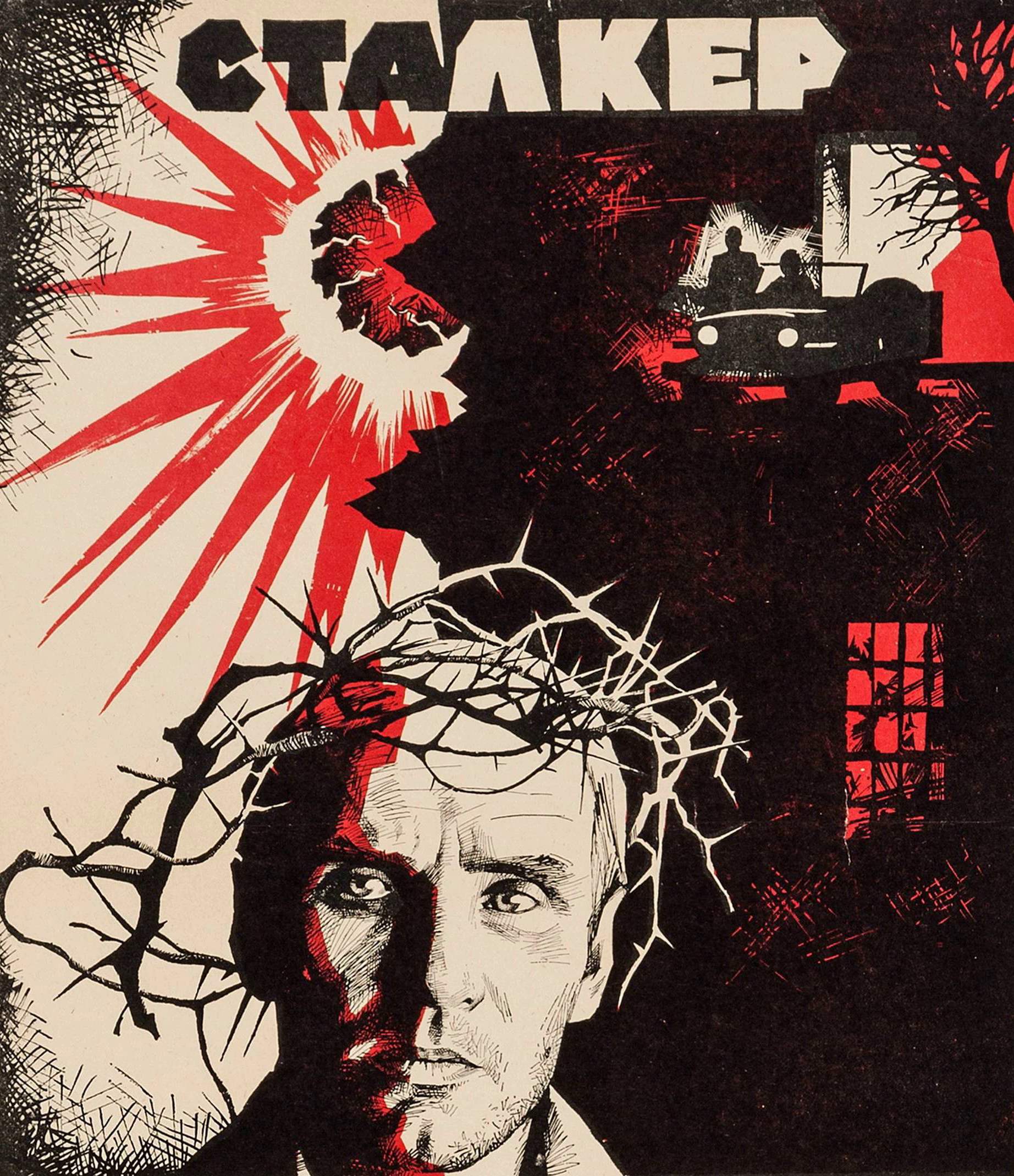
The religious imagery in Stalker is therefore not decorative. The Stalker is an abject guide, a kind of holy fool who leads others into a forbidden place where meaning may still exist, although only in humiliating, dangerous, and inaccessible form. The thorned crown, whether read directly as Christological or more generally as an image of sacrifice and affliction, belongs to a world in which suffering can still be placed inside a larger metaphysical drama. The film does not reduce suffering to therapy. It links suffering to vocation, failed faith, exhausted reason, and the historical ruins of collective projects.
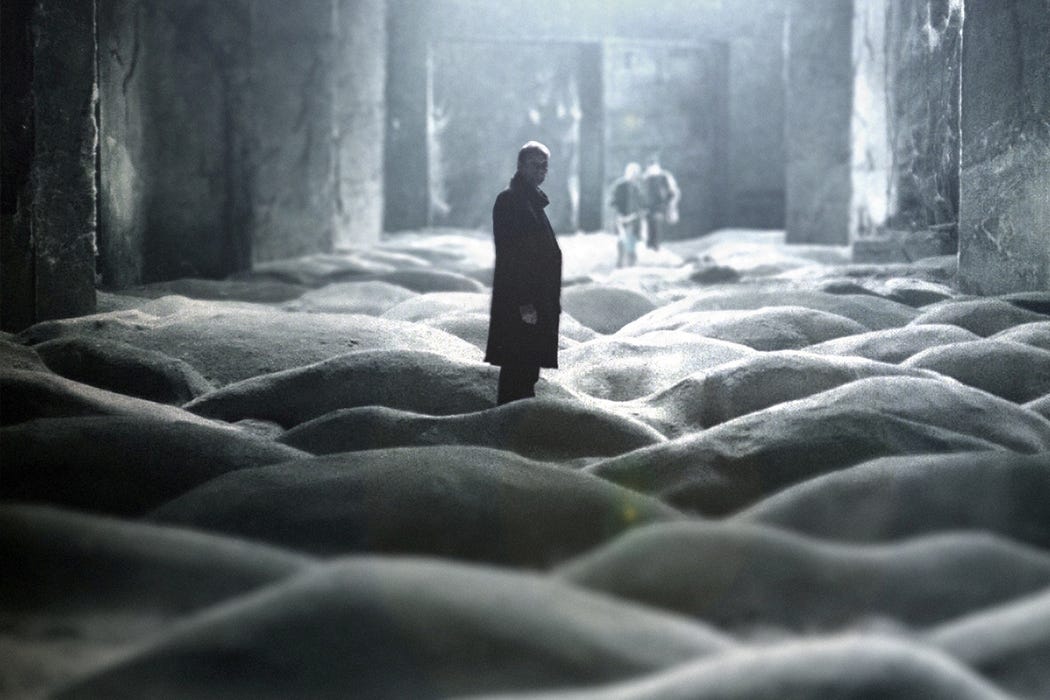
The density of Stalker’s spaces does much of the film’s theoretical work. Tarkovsky’s ruins are wet, industrial, decayed, and material. They carry the weight of failed projects. Pipes, water, concrete, rust, military barriers, abandoned rooms, scientific debris, and flooded interiors all suggest that history has happened here. Something was built, guarded, believed in, and ruined. The Zone may be mysterious, but its mystery is embedded in the remains of solid modernity. Even its unintelligibility has historical thickness.
Backrooms spaces often feel generated rather than ruined. Their horror is procedural. The rooms do not appear to have decayed from some meaningful prior use; they seem copied, repeated, extended, and rendered. This is why simulation becomes such an available interpretation. A world without solid institutional forms increasingly appears as a world without ontology. Things do not feel built; they feel spawned. Spaces do not feel governed; they feel generated. The subject does not confront a social order so much as a hostile environment whose rules are hidden in the code.
This is also where Backrooms intersects with post-bureaucracy. In the bureaucratic imagination, power is located in offices, files, rules, titles, managers, permits, agencies, and corridors of authority. One may hate the bureaucracy, but at least it has a shape. In the post-bureaucratic imagination, the office remains while the organization becomes elusive. Authority is ambient. Rules are opaque. Movement is constrained, but no one appears to be giving orders. The Backrooms are post-bureaucratic space in nightmare form: an infinite office without a boss, a maze of institutional surfaces without an institution that can explain itself.
The film does include a corporate actor, Async, a medical or MRI company that appears to have helped bring the Backrooms into being or to have discovered and exploited them. In an older political thriller, this would likely become the central institutional explanation. A corporation opens a portal, experiments on reality, conceals its crimes, and must be exposed. Backrooms does not use the corporation in that way. Async operates less as a fully narrativized institution than as a conspiratorial signal. It gestures toward private science, medical technology, hidden facilities, and shadowy decision-makers, but it does not restore a solid account of power. The company itself seems to have lost its grip on what it has unleashed.
That difference is revealing. Backrooms is not simply anti-corporate in the old sense because it does not present corporate power as coherent, sovereign, or fully capable of mastering reality. Corporate power appears as one more actor inside the liquefaction of the world. It can open the door, intensify the catastrophe, conceal the anomaly, and damage reality, but it cannot provide intelligibility. Its authority is conspiratorial rather than institutional. It is powerful, but not in control. This is post-bureaucratic capitalism as horror: technical systems, corporate actors, facilities, experiments, devices, and hidden decision-makers all exist, yet none of them restores meaning. The organization is present, but it no longer organizes the world.
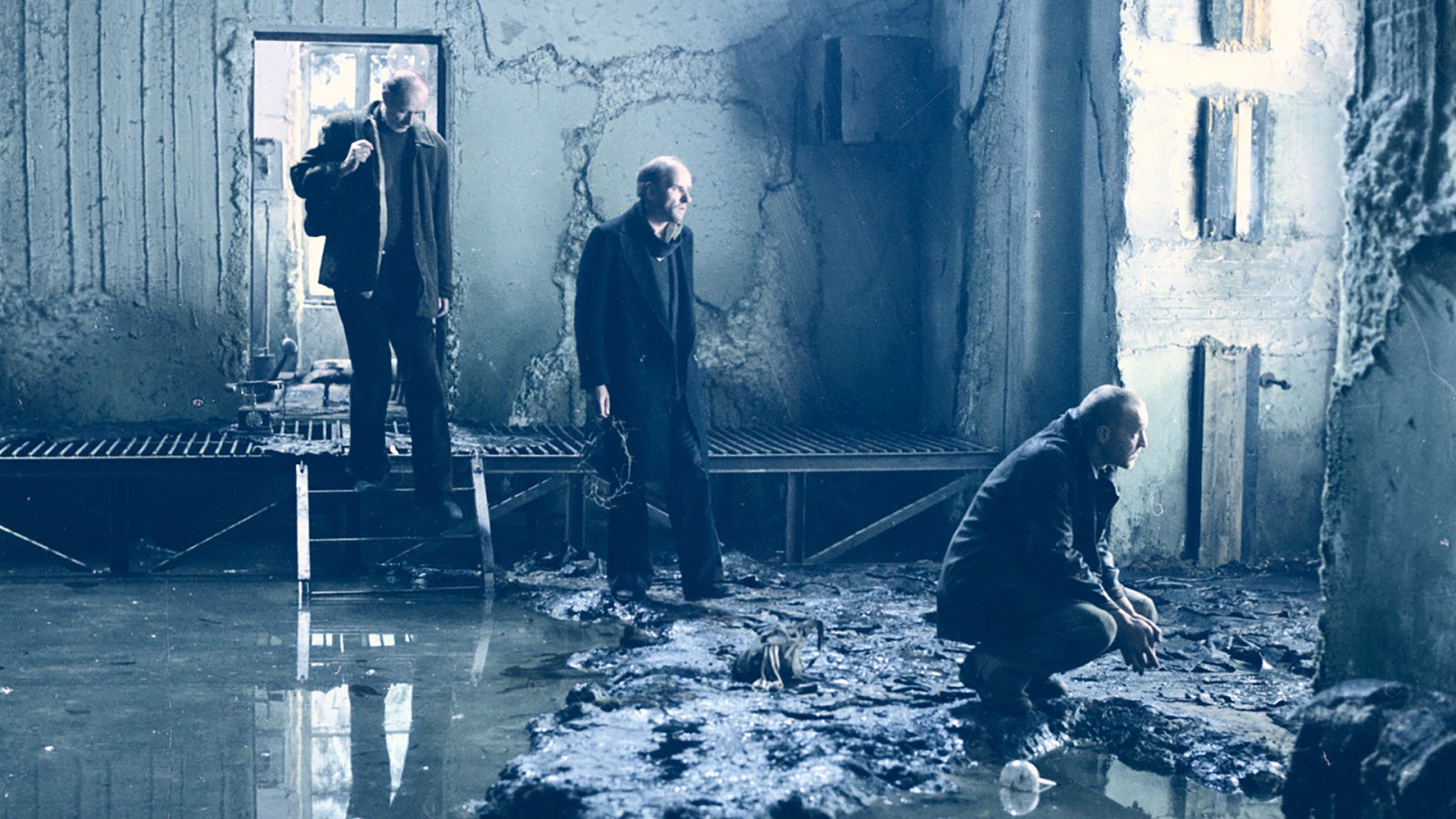
The most important difference between Stalker and Backrooms lies in their treatment of suffering. Stalker is filled with despair, but its despair is not reducible to psychic injury. The characters suffer as persons, but they also suffer as bearers of larger institutional and symbolic crises. The Writer does not merely have trauma; he carries the exhaustion of art. The Professor does not merely have trauma; he carries the crisis of scientific reason. The Stalker does not merely have trauma; he carries faith, vocation, humiliation, and the impossible burden of guiding others through a world whose meaning has become inaccessible. Their suffering is personal, but it is not merely private.
Backrooms translates the breakdown of meaning into the contemporary language of trauma. The pirate figure is not simply a strange monster or an arbitrary fragment from the debris of popular culture. It appears as the protagonist’s traumatized double, perhaps even as an original or displaced version of him. The monster is not external evil in the older religious sense, nor is it simply the unconscious in a Freudian sense. It is personified psychic injury. Trauma becomes a character, a costume, a pursuer, an explanation, and a space-making force. The horror lies not only in being trapped in an unreal place, but in the suggestion that the place itself is organized by a wound that cannot be escaped.
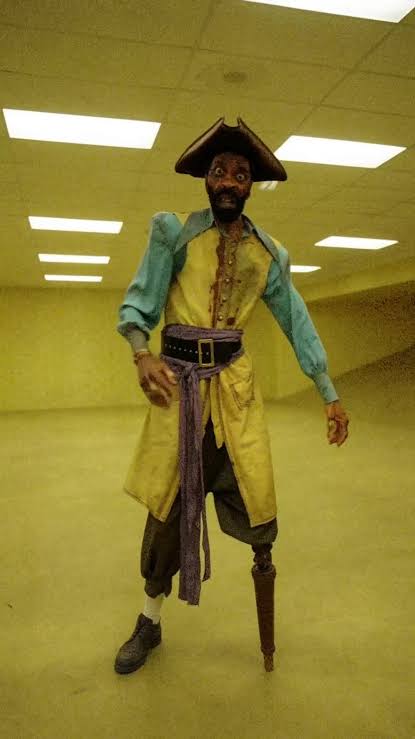
This is increasingly common in contemporary horror. The monster is grief. The ghost is trauma. The house is memory. The demon is repression. The maze is the psyche. The double is the wounded self returning in distorted form. This does not make such films unserious, and it does not mean that trauma is false. The trauma frame registers something real about contemporary life: people are damaged by a world they cannot easily narrate, and that damage appears as anxiety, dissociation, compulsion, fear, and psychic enclosure. The problem is that trauma often becomes an explanation that cannot escape the level of the individual wound.
The reason trauma has become such a dominant macro-frame is that it matches the liquidation of society. Trauma is suffering after social explanation has collapsed into psychic injury. It acknowledges damage, sometimes with great force, but it locates that damage primarily inside the wounded subject. It can describe repetition, triggers, dissociation, memory, distorted perception, and symbolic return, but it struggles to move from the wound back to the social order that produced it. Trauma becomes the last available sociology, but it is a sociology trapped inside the person.
This is why trauma discourse is so compatible with liquid modernity. When institutions no longer appear as durable structures of formation, discipline, authority, and collective meaning, suffering becomes harder to narrate socially. The individual is left to experience structural dislocation as anxiety, depression, compulsion, derealization, damaged memory, and psychic enclosure. What might once have been interpreted through class, alienation, exploitation, secularization, bureaucracy, ideology, or failed collective projects is reinterpreted as injury to the self. The social world does not disappear, but it returns as symptom.
Backrooms expresses this condition almost perfectly. Its setting should invite social explanation: corporate facilities, medical technology, technical experimentation, hidden institutions, office-like interiors, procedural environments, and an endless infrastructure of corridors without public purpose. Yet the film’s deeper explanation returns to the protagonist’s wound. The Backrooms become the architecture of psychic injury, while society appears as atmosphere, conspiracy, or technical accident. The world injures the subject, and then the subject’s injury becomes the world.
This is the limitation of therapeutic horror. It knows that people are damaged, but it often cannot say what kind of society is damaging them except by converting society into symbolic scenery for psychic pain. History becomes backstory. Institutions become mood. Politics becomes healing. Conflict becomes trigger. The house, corridor, monster, or double gives shape to a wound, but the wound remains the final explanatory horizon. The loop closes because the explanation begins with the damaged individual and returns there, even when the scenery is full of institutions that should demand analysis.
Simulation operates in a similar way. It captures the artificiality of life under digital mediation, algorithmic sorting, synthetic images, platform culture, and procedural environments. The simulation frame feels plausible because so much contemporary life is already mediated through systems that render, score, recommend, predict, and manipulate perception. Yet simulation theory often turns a social problem into a metaphysical one. If the world is fake, the task is awakening. If the world is historically organized, the task is analysis and collective transformation. The first is seductive because it preserves the drama of revelation while avoiding the drudgery of rebuilding institutions.
Backrooms stages the convergence of trauma and simulation. The world feels simulated because its structures appear generated, procedural, and unreal. The world feels traumatic because its injuries return as loops, doubles, compulsions, and psychic enclosures. The pirate double gives trauma a face. Async gives simulation a conspiratorial origin. Yet neither frame fully escapes solipsism. The subject is trapped in the architecture of injury, while power is imagined as a shadowy technical force that has also lost control of the system.
This distinguishes Backrooms from Stalker at the deepest level. Stalker confronts unintelligibility, but it does not reduce unintelligibility to the self. The Zone may expose the characters’ desires, failures, and illusions, but it exceeds them. It has objective mystery, material force, and metaphysical danger. It is not simply one person’s trauma projected outward. Backrooms, by contrast, is easily absorbed into a psychologized framework in which space becomes the architecture of injury. The labyrinth is terrifying because it appears to be both outside and inside the self. We are trapped in the world, but also trapped in ourselves, and the two traps blur until they become indistinguishable.
That blur is historically specific. It belongs to a society in which institutions no longer organize shared meaning effectively, but still shape life through technical systems, market pressures, corporate infrastructures, digital platforms, therapeutic vocabularies, and privatized risk. The world does not become free when institutions melt. It becomes harder to locate power. The disappearance of solid forms does not eliminate constraint; it makes constraint environmental, psychological, procedural, and ambient.
This is the link between Bauman’s liquid modernity and post-bureaucracy. Bauman emphasized the weakening of durable social forms and the resulting burden placed on individuals to navigate uncertainty. Post-bureaucratic organization theory shows that the weakening of formal bureaucracy does not abolish authority, but relocates it into culture and technique. Stalker and Backrooms translate these problems into space. Stalker imagines a world where solid modernity is decaying but still remembered. Backrooms imagines a world after that memory has become unstable, memeified, and psychologized.
The generational difference is therefore not incidental. Stalker was made by a filmmaker formed in a world where the great institutional languages of modernity still pressed on consciousness, even when they had become bankrupt or terrifying. Backrooms comes from a filmmaker formed within internet culture, where institutions are often encountered less as solid moral structures than as interfaces, conspiracies, images, platforms, glitches, therapeutic wounds, and aesthetic atmospheres. A filmmaker formed in that world does not need to invent liquid modernity. He inherits it. The strange achievement of Backrooms is that it does not describe the melting of stable reality from the outside. It speaks from inside the melt.
The limitation follows from the same condition. If Backrooms can interpret liquefied reality only through other liquefied frames, then it risks becoming trapped in the very solipsism it depicts. Trauma explains why the subject cannot leave. Simulation explains why the world feels false. Conspiracy explains why some corporate actor seems to be standing behind the door. But none of these frames fully explains who built the rooms, why the lights remain on, why the corridors resemble workplaces, why the institutional environment persists without public purpose, or why contemporary people so readily recognize these spaces as their own unconscious. Without sociology, the Backrooms remain therapeutic metaphysics. With sociology, they become the spatial imaginary of post-bureaucratic capitalism.
The task is not to reject the trauma or simulation readings. Both capture something true about contemporary experience. People feel simulated because more of social life is technically mediated, procedurally generated, and algorithmically organized. People feel traumatized because insecurity, abandonment, social fragmentation, and institutional failure are lived through the body and psyche. The problem is not that these frames are wrong. They become inadequate when they detach psychic experience from social structure.
Stalker could still ask what happens when faith, art, science, and authority fail to make the world meaningful. Backrooms asks what happens when those failures are inherited as atmosphere, when institutional collapse is no longer remembered as collapse, and when the available explanations have narrowed to simulation and trauma. In Stalker, the Zone is a metaphysical wound in the landscape of solid modernity. In Backrooms, the labyrinth is the psychic architecture of liquid modernity: endless interiors, unstable origins, corporate residue, traumatized doubles, procedural space, and the terrible suspicion that the way out may only lead to another level of the same damaged system.
The most frightening thing about the Backrooms is not that one might never find the exit. It is that the exit may no longer be imaginable as a social form. Escape appears as individual awakening, therapeutic breakthrough, or movement to another level of the maze. What is missing is the possibility of rebuilding the world outside the rooms. That absence is the real horror. We are not simply lost. We have forgotten what kind of institutions would make being found meaningful.
References
Attwood-Charles, William. 2018. Post-Bureaucratic Organizations: Normative and Technical Dimensions. PhD diss., Boston College.
Bauman, Zygmunt. 2000. Liquid Modernity. Cambridge: Polity.
Charles, William. 2025. “Making the Collectivist Organization: Creativity, Conformity, and Social Closure.” Poetics 109:101982.
Charles, William, and Juliet B. Schor. 2025. “Distinction at Work: Status Practices in a Community Production Environment.” Journal of Contemporary Ethnography 54(3):391–422.
Fisher, Mark. 2016. The Weird and the Eerie. London: Repeater.
Parsons, Kane, dir. 2026. Backrooms. A24.
Strugatsky, Arkady, and Boris Strugatsky. 1972. Roadside Picnic.
Tarkovsky, Andrei, dir. 1979. Stalker. Mosfilm.