The Two Control Regimes of Post-Bureaucratic Capitalism
Normative control for elite workers, technical control for everyone else
When I wrote my dissertation, I was trying to understand what happens when organizations reject bureaucracy but still need order. One case was a makerspace organized around creativity, autonomy, community, and informal collaboration. The other cases were gig platforms that organized courier work through apps, ratings, customer feedback, and opaque digital systems. At the time, these seemed like distinct organizational worlds. The makerspace appeared to be a voluntary community of creative production, while the platforms represented precarious labor mediated by software. In retrospect, they now look like two classed futures of work. The makerspace showed how elite and aspiring-elite workers are governed when formal hierarchy is weak: through culture, identity, status, taste, peer judgment, and the pressure to become the right kind of person. The platforms showed how precarious workers are governed when formal employment is denied: through ratings, metrics, nudges, opacity, and the permanent threat of exclusion.
The argument that came out of this work is not simply that bureaucracy has declined. It is that authority has migrated. In some organizations, authority moves into norms, culture, identity, and informal status. In others, it moves into technical systems that measure, schedule, rank, and discipline workers. These are not equally distributed modes of control. Elite and professional workers are increasingly governed through normative control, while precarious, low-wage, and frontline workers are governed through technical control. The former are invited to internalize organizational demands as vocation, authenticity, creativity, or self-realization. The latter are made legible to systems that care little about identification and very much about compliance.
This does not mean elite workers are free or that normative control is benign. Normative control can be intimate, exhausting, and difficult to resist because it works through the self. The organization does not merely demand labor time. It demands passion, flexibility, resilience, cultural fluency, and a recognizable form of selfhood. Workers must anticipate what the institution values and present their own overextension as commitment. The academic, nonprofit worker, designer, journalist, consultant, software engineer, or startup employee may not experience work as direct command, but the absence of explicit command is part of the mechanism. The organization becomes effective precisely because it has been installed inside the worker’s own sense of worth.
Technical control operates through a different logic. It does not require the courier, warehouse worker, call center employee, cashier, fast food worker, home care aide, or delivery driver to believe in the organization’s mission. It requires the task completed, the route followed, the call handled, the package scanned, the rating preserved, the quota met, the shift accepted, the idle time reduced, and the system obeyed. The worker is not cultivated as a full organizational subject. The worker is treated as a unit of throughput, made visible through performance data and disciplined through the infrastructure of work. The supervisor does not necessarily disappear, but supervision is redistributed into scheduling software, dashboards, customer ratings, productivity metrics, algorithmic routing, automated warnings, and opaque systems of evaluation.
The promise of post-bureaucracy was that organizations would move beyond rigid hierarchy. In management discourse, this appeared as a shift from command and control to flexibility, participation, teamwork, culture, networks, and autonomy. In the broader culture, bureaucracy became shorthand for dead institutional life: gray offices, standardized roles, procedural stupidity, middle managers, and the suffocating weight of rules. There was plenty to criticize in bureaucracy. It could be rigid, exclusionary, impersonal, and cruel. Yet bureaucracy had one accidental virtue: it made authority visible. There were offices, titles, managers, procedures, and chains of command. Post-bureaucracy often keeps authority while making it less visible, less accountable, and more difficult to contest. Authority migrates into culture for some workers and technology for others.
In Distinction at Work, Juliet Schor and I used the makerspace case to show how a structurally flat organization generated informal status hierarchy through cultural capital, aesthetic judgment, and practices of distinction. The absence of formal hierarchy did not eliminate hierarchy. It displaced hierarchy into informal recognition, peer evaluation, and the ability to perform the right relationship to creativity, technical competence, and community. In Making the Collectivist Organization, I developed the related argument that an organization committed to creativity and nonconformity could still produce conformity and social closure. The members pursued an artistic critique of capitalism, centered on meaning, creativity, and expressive production, while repressing a social critique concerned with inequality and inclusion. This is the paradox at the center of many post-bureaucratic organizations: they reject the old forms of domination while reproducing hierarchy through culture.
That paradox has become more general. In elite workplaces, authority increasingly appears as culture. Workers are invited to care, create, collaborate, innovate, belong, and bring their whole selves to work, provided that the selves they bring have already been optimized for institutional approval. In these settings, domination often appears as voluntary overextension. No one has to order people to work too much when work is linked to identity, status, moral purpose, and the hope of recognition. For less protected workers, by contrast, authority increasingly appears as technical necessity. Schedules, ratings, dashboards, and performance metrics present themselves as neutral facts rather than managerial decisions. The worker may not have a boss in the traditional sense, but the boss relation has been encoded into the infrastructure of labor.
One important change is that normative control itself has shifted. In older professional and bureaucratic orders, elite respectability was organized heavily through manners. These manners were classed, exclusionary, and often humiliating, but they were at least partly legible as rules. One could learn how to dress, speak, write, shake hands, sit in a meeting, modulate one’s voice, appear punctual, and perform bourgeois restraint. The old professional world had codes, and while those codes were unfair, they could often be identified. Contemporary normative control is more encompassing because it extends beyond manners into an entire style of life. Elite workers are not merely expected to behave properly at work. They are expected to appear as a certain kind of person: healthy, energetic, emotionally regulated, aesthetically competent, socially fluent, politically tasteful, physically disciplined, and capable of presenting self-control as ease.
The body has become a central site of this classed control. Fitness and diet are not merely private practices. They increasingly function as signs of discipline, competence, and moral worth. The right body, the right relationship to food, the right exercise habits, the right sleep discourse, the right alcohol norms, the right therapeutic vocabulary, the right casual familiarity with running, cycling, yoga, protein, farmers markets, supplements, meditation, and clean eating can all become part of elite professional style. The point is not any single practice. The point is the conversion of lifestyle into evidence of self-command. This is harder for working-class people to launder than older manners because lifestyle distinction requires accumulated advantages: time, money, stable schedules, safe neighborhoods, good food, health care, dental care, leisure, sleep, social confidence, and distance from the chronic stress of scarcity. The professional body is not simply chosen. It is produced by a class infrastructure.

The recent NPR story on socioeconomic factors becoming biologically embedded in children’s brains gives this argument a more unsettling edge. The finding should not be read as biological determinism. It should be read in the opposite direction: biology is not outside society. The body is one of the places where society accumulates. If sleep, stress, neighborhood conditions, family resources, and household stability shape development, then a worker’s posture, energy, teeth, weight, skin, sleep, stress response, affective ease, dietary habits, and relation to exercise are not simply personal choices. They are traces of social organization. When elite workplaces convert these features into judgments about confidence, professionalism, energy, self-care, or fit, they launder structural advantage into apparent personal virtue.
This is why the shift from manners to lifestyle is so consequential. Manners could be learned, at least to some degree, as an external code. Lifestyle distinction is harder to acquire because it depends on a whole ecology of prior conditions. The child who grows up in a safe neighborhood, sleeps well, eats well, receives dental care, plays organized sports, learns the etiquette of restaurants and gyms, and sees adults managing stress through therapy and leisure is not merely learning preferences. They are accumulating an embodied relation to the world. They are learning how to appear natural in elite institutions before they ever apply to them. Working-class people, of course, do not lack discipline. Many endure forms of bodily discipline that elite professionals could not tolerate for long: physical labor, shift work, pain, exhaustion, caregiving, long commutes, unstable schedules, and the continuous management of necessity. But this discipline is rarely recognized as refinement. It appears as survival rather than distinction. Elite bodily discipline is valued because it appears voluntary, aesthetic, and self-directed, while working-class bodily discipline is devalued because it is visibly connected to constraint.
The language of authenticity is central to this regime. Elite workers are not supposed to seem merely obedient, polished, or professional. They are supposed to seem authentic. Yet this authenticity is not the absence of performance. It is a higher-order performance that demonstrates continuous work on the self. The authentic elite worker is expected to be self-aware, emotionally regulated, health-conscious, politically tasteful, aesthetically coherent, therapeutically literate, morally reflective, vulnerable without being destabilizing, disciplined without appearing rigid, and ambitious without seeming crass. Even vanity can now be incorporated into this moral economy, provided it is narrated as optimization, wellness, embodiment, health, empowerment, or spiritual discipline.
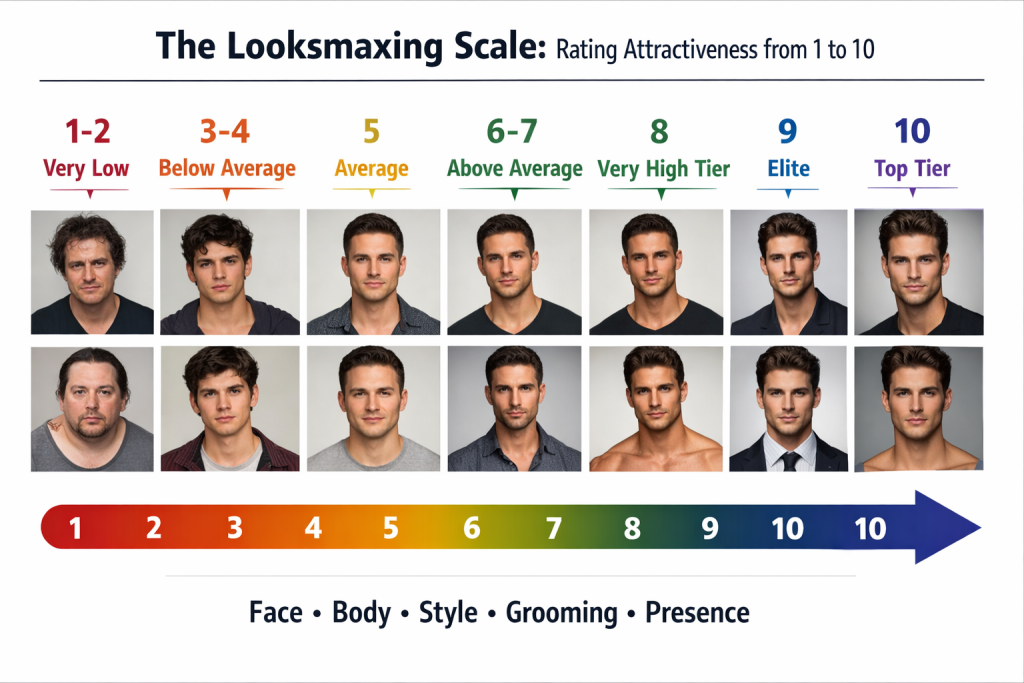
The language of looksmaxxing is revealing because it makes crude what elite culture often keeps polished. In its online forms, looksmaxxing treats the body as a competitive asset to be optimized, rated, ranked, and displayed. The term comes from toxic corners of internet culture, but its vulgarity exposes a broader tendency: the body is increasingly treated as a project of maximization. Appearance becomes strategy, discipline, market positioning, sexual competition, self-command, and sometimes moral redemption. What looks ridiculous in looksmaxxing appears in softer and more legitimate form across elite culture: fitness routines, diet regimes, skin care, cosmetic procedures, expensive athleisure, quantified sleep, therapy language, supplements, and the conversion of health into visible status. Contemporary authenticity does not require the disappearance of vanity. It requires vanity to be morally laundered.
Goop is the refined version of the same cultural form. It matters not because every professional-class worker literally consumes Goop products, but because Goop crystallizes the moral economy of elite self-work. It translates privilege into wellness, consumption into agency, vanity into embodiment, and distinction into authenticity. Its genius is that it does not present elite lifestyle as mere luxury. It presents it as care of the self, a search for depth, a refusal of shame, a commitment to health, and a more intentional way of living.

Goop shows how post-bureaucratic normative control escapes the workplace and becomes a whole style of life. The worker who enters elite institutions is not merely expected to possess credentials or manners. They are expected to possess an entire relation to the self: a body under discipline, a diet under reflection, emotions under therapeutic management, sexuality under curated openness, consumption under the sign of intentionality, and taste disguised as self-knowledge. Goop is not simply selling products. It is selling the fantasy that class distinction is self-realization.
The absurdity of some Goop controversies should not distract from the deeper social logic. The wellness summit, the clean-eating aesthetic, the expensive skin care, the ritual objects, the deliberately provocative branding: these are easy to mock, and often deserve it. But mockery alone misses why the form is powerful. Goop offers elite consumers a way to experience consumption as inner work. Buying the right objects, eating the right foods, attending the right summit, adopting the right rituals, and narrating the body through the right language all become signs that one is not merely rich or status-conscious, but awake, embodied, healed, optimized, and authentic.
In that sense, Goop is not a deviation from elite culture. It is elite culture saying the quiet part in a spa voice. The old bourgeoisie displayed refinement through manners, art, education, restraint, and philanthropic seriousness. The contemporary professional elite increasingly displays refinement through wellness, therapeutic literacy, bodily discipline, political taste, and morally upgraded consumption. The point is not to appear above materiality, but to turn every material practice into evidence of personal growth. Food is not just food. Exercise is not just exercise. Skin care is not just skin care. The body becomes a moral document.
This is conformist authenticity. Its purpose is not to free the self from social codes but to demonstrate mastery of a new code: the code of self-cultivation. The self must appear natural only after extensive regulation. It must appear spontaneous only in approved forms. It must reject old bourgeois stiffness while reproducing bourgeois distinction through the body, diet, leisure, affect, politics, and taste. Older professional respectability emphasized manners, while the new respectability emphasizes self-work. The striving upper middle class must convert discipline into authenticity and then misrecognize that discipline as personal liberation. This is one of the more elegant tricks of post-bureaucratic capitalism: it turns class reproduction into a spiritual project.
Authenticity also functions as class distinction because it differentiates the disciplined professional subject from those imagined as unregulated, unhealthy, excessive, reactive, addicted, vulgar, conspiratorial, angry, or insufficiently self-aware. The judgment rarely has to be stated crudely. It operates through aversion, humor, discomfort, hiring, dating, friendship, mentoring, institutional fit, and the quiet sense that some people have failed to become the right kind of person. In this setting, class does not announce itself as class. It appears as maturity, health, taste, emotional intelligence, moral sensitivity, and the capacity to narrate personal growth.
There is a bitter irony here. The working class may now appear more authentic in a literal sense, though not in a romantic one. This is not because working-class life is pure or outside culture. It is because society has largely abandoned the older project of integrating workers into a shared moral order. Stable employment, unions, churches, parties, public schools, local newspapers, civic associations, and mass culture once helped organize working-class life into durable forms of belonging and discipline. Many of those institutions have weakened, leaving people exposed to debt, surveillance, unstable work, fragmented media, addiction markets, consumer culture, and platform-mediated spectacle. The result is not liberation from bourgeois hypocrisy but authenticity under conditions of decomposition.
This is the sense in which lumpenization has to be understood carefully. It should not be used as a moral insult against working-class people. It describes a social process in which institutions that once organized class experience into durable solidarities have weakened, leaving more people exposed to fragmented survival strategies, informal economies, addiction, spectacle, and anti-social forms of escape. Working-class people are not naturally lumpen. They are made more lumpenized when collective institutions collapse and market culture fills the void. Digital platforms intensify this process by monetizing impulse, grievance, sexual display, gambling, conspiracy, cruelty, humiliation, and fantasy. What appears as raw authenticity is often social disorganization processed through the algorithm.
At the other end of the class structure, the ultra-rich are also increasingly lumpenized, though in a different form. Earlier elites often felt compelled to present wealth as cultivation: patronage, restraint, philanthropy, manners, taste, public service, moral seriousness. Much of this was hypocrisy, but hypocrisy at least acknowledged the need for justification. The contemporary ultra-rich often do not need even that. Their wealth is insulated by assets, law, technical systems, private security, tax structures, and political access. Refinement becomes optional because their position no longer depends on being recognized as morally superior by a shared public. Excess itself can become a badge of impunity.

This is the opposite pole from Goop. Goop sells discipline as depth, consumption as healing, and bodily regulation as authenticity. Elite lumpenization dispenses with that labor of justification. It does not need to launder excess through wellness or spiritualized self-work. It can present indulgence, provocation, vulgarity, drug use, sexual libertinism, impulsiveness, and contempt for restraint as signs of genius, freedom, or authenticity. The old bourgeoisie had to pretend that wealth refined the person. The new ultra-rich often present wealth as liberation from the need to be refined at all.
This does not make the ultra-rich authentic in any emancipatory sense. It means they can afford to abandon the performance of refinement without losing status. What would mark a working-class person as irresponsible or pathological can mark an ultra-elite figure as interesting, eccentric, disruptive, or refreshingly unfiltered. The same behavior is read differently because class position changes its meaning. At the bottom, disinhibition is treated as evidence of disorder. At the top, it is treated as charisma.
This produces a strange convergence between the abandoned working class and the insulated ultra-rich. Both can appear freed from bourgeois discipline, though for opposite reasons. One is abandoned by institutions, while the other is above them. One is exposed to precarity, extraction, digital pacification, and social decomposition, while the other is protected by wealth from the consequences of excess. Both can drift toward anti-institutional forms of authenticity: drugs, spectacle, gambling, impulsiveness, conspiracy, cruelty, sexual libertinism, and the refusal of restraint. The difference is that one experiences this as abandonment and the other as impunity.
The striving upper middle class remains the most committed to discipline because it has to be. Its members are neither abandoned enough to escape normative judgment nor powerful enough to ignore it. They must prove their worth continuously through education, credentials, bodily regulation, moral language, therapeutic self-understanding, career discipline, and lifestyle coherence. Their bodies, diets, emotions, politics, leisure practices, and self-narratives become evidence that they belong. This is why normative control is concentrated most intensely on those who are close enough to elite institutions to need recognition, but not secure enough to dispense with it. In this part of the class structure, discipline masquerades as self-discovery.
Once class has been written into the body, post-bureaucratic capitalism sorts bodies into different regimes of control. Some bodies are cultivated through norms, while others are managed through metrics. The elite body is read as promise, and the precarious body is read as throughput. This helps explain why much contemporary left-liberal discourse about work is shaped by people governed primarily through normative control. Their experience of domination is real: burnout, over-identification, loss of boundaries, status anxiety, moralized work, lifestyle pressure, and the demand to turn the self into a permanent professional project. Yet when this experience is universalized, it produces a distorted picture of labor as a whole.
For many workers, the problem is not that work asks them to bring their whole self. The problem is that work treats the self as irrelevant. The warehouse worker, delivery driver, fast food worker, home care aide, cashier, call center employee, or gig courier is not typically invited into a culture of creative self-realization. They are scheduled, tracked, measured, rated, and replaced. They are not asked to become the organization. They are asked to remain compatible with the system. This distinction helps explain the limits of certain professional-class labor imaginaries, especially demands centered on boundaries, flexibility, remote work, mental health, self-care, and work-time reduction. These demands may be justified, but they do not automatically address the conditions of workers governed through technical control.
A four-day week means one thing in a meeting-saturated professional workplace where much labor consists of coordination rituals, email sludge, and performative busyness. It means something else in care work, logistics, warehouses, transit, food service, sanitation, teaching, manufacturing, and emergency services, where work is tied to coverage, presence, staffing, and throughput. The point is not to oppose shorter hours. Workers should have more control over time. The point is that the pathologies of elite work cannot be mistaken for the general structure of labor. The professional worker may need protection from over-identification. The precarious worker may need power over the system that schedules, ranks, tracks, and disciplines them. Both demands are legitimate, but they emerge from different control regimes.
The same distinction clarifies the limits of anti-bureaucratic politics. Professional workers often experience bureaucracy as constraint: paperwork, compliance, meetings, administrative stupidity, dead language, and procedural drag. They are therefore drawn to autonomy, flexibility, informality, and trust. For workers lower in the labor market, however, formal rules can sometimes be protective. A clear schedule, a grievance procedure, a seniority system, a staffing ratio, a written contract, an enforceable break, or a transparent disciplinary process may be more emancipatory than another celebration of flexibility. One person’s liberation from bureaucracy can become another person’s exposure to arbitrary discretion or algorithmic control.
The problem is not whether organizations are formal or informal, hierarchical or flat, bureaucratic or post-bureaucratic. The better questions are where authority is located, how it operates, and whether workers can contest it. In elite settings, authority is often hidden in culture: who belongs, who has taste, who seems smart, who has the right body, who speaks the right moral language, who appears relaxed under pressure, who can perform authenticity in the approved register. In precarious settings, authority is hidden in systems: who gets the shift, who gets the order, who gets deactivated, who is visible to the algorithm, who is penalized by the rating, who can challenge the metric, who designed the dashboard. In both cases, the mechanisms of control are presented as something other than power. Culture appears as community, technology as efficiency, lifestyle as health, metrics as objectivity, and flexibility as freedom.
A serious labor politics has to see normative and technical control as connected parts of the same post-bureaucratic order. The elite worker governed through passion and the precarious worker governed through ratings do not occupy unrelated worlds. They occupy different locations in the same political economy. One is asked to internalize capital’s demands as identity. The other is forced to meet capital’s demands as data. This requires a richer theory of class than income alone. Class is also how one is controlled, how one is evaluated, how one is allowed to appear, and whether one’s personhood is cultivated or ignored. Elite workers are often exploited through recognition, while precarious workers are exploited through replaceability. Elite workers are told they are meaningful to the institution, sometimes crushingly so. Precarious workers are often told, in practice, that they barely register except as performance data.
The connecting principle should be democratic control over work. Workers should have power over the norms that define value and belonging, and they should also have power over the technologies that measure, schedule, rank, and discipline them. This requires more than workplace wellness or better management. It requires unions, sectoral bargaining, public regulation, worker councils, transparent algorithms, enforceable scheduling rights, limits on surveillance, democratic control over productivity standards, and collective power over the organization of time. It also requires challenging elite lifestyle distinction as a covert form of class reproduction. A democratic workplace cannot be one in which some workers must embody distinction while others are reduced to metrics.
The future of work is often described as if technology is the main problem. That is too narrow. The future of work is also cultural. It is about the kinds of persons organizations reward, the bodies they prefer, the lifestyles they treat as evidence of competence, and the class backgrounds they quietly recognize as fit. At the same time, culture alone is not enough. The hardest forms of domination now often arrive through systems that claim to be impersonal, efficient, and objective. Post-bureaucratic capitalism therefore decomposes bureaucratic authority and redistributes it through culture and technology, producing a subtle class order rather than a classless workplace.
The task is to make that order visible. Elite workers are governed by norms that appear as lifestyle, authenticity, and self-realization. Precarious workers are governed by systems that appear as metrics, platforms, and efficiency. A serious critique of contemporary capitalism has to hold both together, or it will keep mistaking one class’s experience of work for everyone’s. The problem is not simply that some workers get vibes and others get dashboards. The problem is that neither the vibes nor the dashboards are democratically governed.
References
- Attwood-Charles, William. 2018. Post-Bureaucratic Organizations: Normative and Technical Dimensions. PhD diss., Boston College.
- Bogost, Ian. 2026. “People Are Thinking About Looksmaxxing All Wrong.” The Atlantic, March 31.
- Boltanski, Luc, and Ève Chiapello. 2005. The New Spirit of Capitalism. London: Verso.
- Bourdieu, Pierre. 1984. Distinction: A Social Critique of the Judgement of Taste. Cambridge, MA: Harvard University Press.
- Braverman, Harry. 1974. Labor and Monopoly Capital: The Degradation of Work in the Twentieth Century. New York: Monthly Review Press.
- Charles, William. 2025. “Making the Collectivist Organization: Creativity, Conformity, and Social Closure.” Poetics 109:101982. https://doi.org/10.1016/j.poetic.2025.101982.
- Charles, William, and Juliet B. Schor. 2025. “Distinction at Work: Status Practices in a Community Production Environment.” Journal of Contemporary Ethnography 54(3):391–422. https://doi.org/10.1177/08912416251336208.
- Edwards, Richard. 1979. Contested Terrain: The Transformation of the Workplace in the Twentieth Century. New York: Basic Books.
- Hamilton, Jon. 2026. “Socioeconomic Factors Are Becoming ‘Biologically Embedded’ in Children’s Brains.” NPR, June 11. https://www.npr.org/sections/shots-health-news/2026/06/11/nx-s1-5425197/socioeconomic-status-brain-development-children.
- Kellogg, Katherine C., Melissa A. Valentine, and Angèle Christin. 2020. “Algorithms at Work: The New Contested Terrain of Control.” Academy of Management Annals 14(1):366–410.
- Kunda, Gideon. 2006. Engineering Culture: Control and Commitment in a High-Tech Corporation. Revised ed. Philadelphia: Temple University Press.
- Lamont, Michèle. 1992. Money, Morals, and Manners: The Culture of the French and the American Upper-Middle Class. Chicago: University of Chicago Press.
- Marek, Scott, et al. 2025. “Patterns of Brain-Wide Associations Reflect Socioeconomics.” Science. https://pubmed.ncbi.nlm.nih.gov/41427390/.
- Rosenblat, Alex. 2018. Uberland: How Algorithms Are Rewriting the Rules of Work. Oakland: University of California Press.
- Vallas, Steven P. 2003. “Why Teamwork Fails: Obstacles to Workplace Change in Four Manufacturing Plants.” American Sociological Review 68(2):223–250.
- Zuboff, Shoshana. 1988. In the Age of the Smart Machine: The Future of Work and Power. New York: Basic Books.